Drug discovery and protein structure figure templates
4 editable figure templates on protein structure and AI for proteins: AlphaFold predictions with pLDDT and PAE, the AlphaFold 2 and 3 architectures, the folding energy landscape, and coevolution to protein language models.
Protein structure figures for drug discovery
These templates cover the structural side of early drug discovery: predicting the structure of a target, judging how far that prediction can be trusted, and explaining the models and the physics behind it. They are built for methods figures, reviews, teaching slides and talks, where a predicted structure has to be shown honestly, with its confidence, rather than as if it were an experimental one.
Each template follows the papers it cites (AlphaFold 2 and 3, the AlphaFold Protein Structure Database, the folding funnel, direct-coupling analysis and the ESM language models). Structures, alignments and confidence maps are synthetic examples drawn to show the idea; the numbers in the captions come from the papers.
Showing AlphaFold confidence correctly
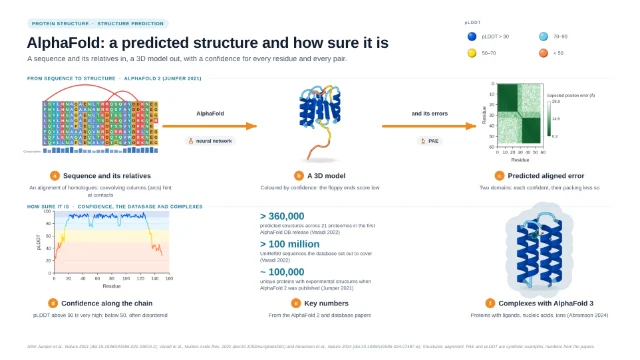
- pLDDT. A per-residue score from 0 to 100. The AlphaFold Database colours it in four bands: above 90 very high (dark blue), 70–90 confident (light blue), 50–70 low (yellow) and below 50 very low (orange). Regions below 50 are often intrinsically disordered rather than wrongly folded.
- PAE. The predicted aligned error, in ångströms: the expected error in the position of one residue when the model is superposed on another. Low PAE between two domains means their relative placement is reliable, whatever their individual pLDDT.
- ipTM. For complexes predicted with AlphaFold 3 or AlphaFold-Multimer, the interface score. Values above 0.8 indicate a confident prediction of the interface; values below 0.6 suggest it has likely failed.
Colour a predicted structure by pLDDT, or give the scores in a legend, whenever it appears in a figure. Add the PAE map when the figure makes a claim about how domains pack or how two chains meet.
What a predicted structure cannot tell you
A prediction is one static state. Alternative conformations, induced fit and dynamics are missed, and a binding pocket in a structure predicted without its ligand may not have the shape it takes when the ligand is bound. Before using a model for docking or structure-based design, compare it with any experimental structures of the same or related proteins in the PDB, and say in the caption which model and version you used.
A checklist for protein figures
- Source. Give the PDB ID, or the prediction method, version and database entry, in the caption.
- Representation. Cartoon for the fold, surface for pockets and interfaces, sticks for ligands and the residues you discuss.
- Orientation. Keep the same view across panels so readers can compare them; rotate only with a clear reason.
- Colour. Use one colour scheme per property, with a legend, and avoid relying on red against green alone.
For a results figure that combines a structure with plots, the multipanel templates include a four-panel example built around a predicted protein structure and its confidence.
Questions
What templates are there for drug discovery & proteins?
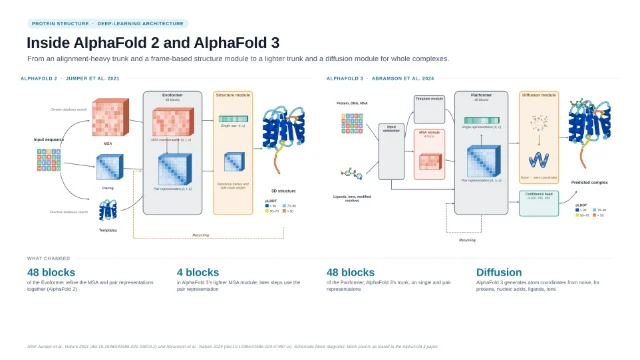
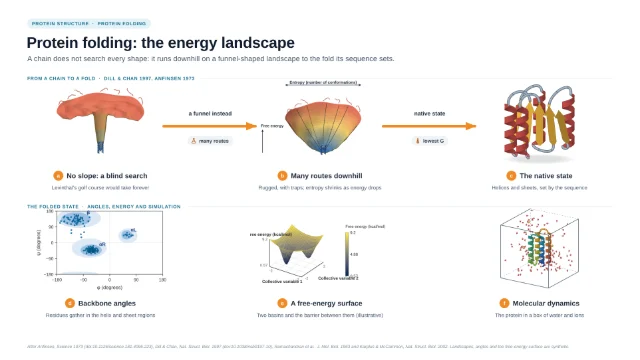
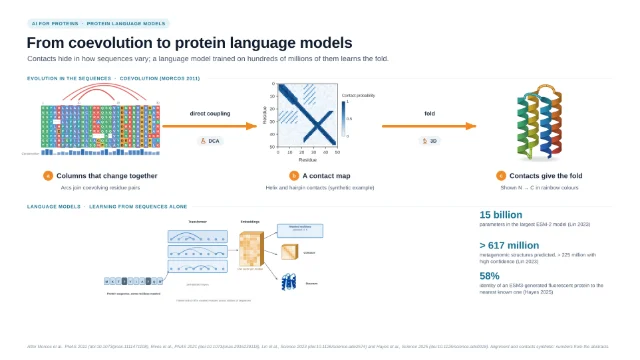
4: AlphaFold: a predicted structure and how sure it is; Inside AlphaFold 2 and AlphaFold 3; Protein folding: the energy landscape; From coevolution to protein language models.
Which papers are these templates based on?
Together they follow 15 published papers; each template’s page lists its own, with DOIs, and the figure credit names them too.
How do I use one of these templates?
Open its page and click Open in the editor. Sign in, or create an account, and it opens in the LabCanvas figure editor as your own design, with every layer editable.
How should I colour an AlphaFold structure?
By pLDDT, using the AlphaFold Database bands: above 90 dark blue, 70–90 light blue, 50–70 yellow and below 50 orange. State the bands in the legend so readers can tell confident regions from likely disordered ones.
Can I use AlphaFold Database structures in a published figure?
Yes. The AlphaFold Database makes its predictions available under the CC BY 4.0 licence; cite Jumper et al., Nature 2021 and the database paper (Varadi et al., Nucleic Acids Research). Predictions made with the AlphaFold 3 server come with their own terms of use, so check those before publishing or commercial use.
Are the structures in these templates real predictions?
No. They are synthetic examples drawn to show how the outputs look and what they mean. Replace them with your own structure; the captions and numbers quoted from the papers stay correct.
Make it your own figure
Start from a template and change anything: the text, the colours, the structures.
Create an account Sign in