Graphical abstract template · Graphical abstracts · Graphical abstract
Thermoelectrics: scattering heat-carrying phonons at every length scale
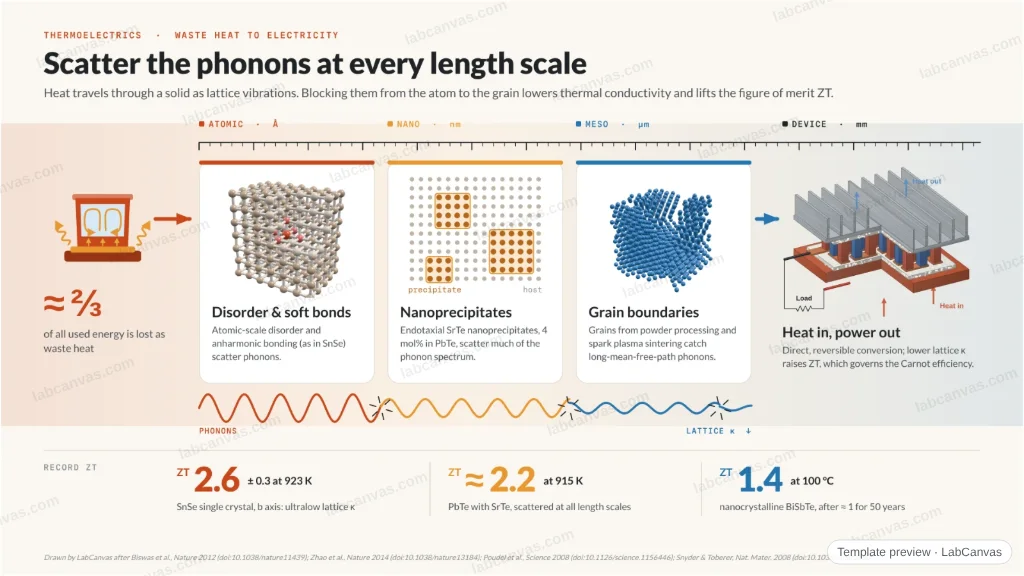
A length-scale ladder for thermoelectric materials: waste heat enters, and the phonons that carry it are scattered by atomic disorder and anharmonic bonds, by nanoscale precipitates and by mesoscale grain boundaries before a thermoelectric module turns heat into electricity. Record figures of merit from SnSe crystals, hierarchical PbTe–SrTe and nanocrystalline BiSbTe run along the bottom.
Updated 4 cited papers334 editable layers
At a glance
- Category
- Graphical abstracts
- Method
- Graphical abstract
- Starting materials
- Waste heat carried through a solid by phonons
- Product
- A thermoelectric module that turns heat directly into electricity
- Key result
- ZT 2.6 ± 0.3 at 923 K, SnSe b axis (Zhao et al. 2014); ZT ≈ 2.2 at 915 K, PbTe–4 mol% SrTe (Biswas et al. 2012); ZT 1.4 at 100 °C, nanocrystalline BiSbTe, after ≈ 1 for 50 years (Poudel et al. 2008)
- Figure
- 1920 × 1080 px (16:9), 334 editable layers, 2 generated objects
Step by step
- Waste heatAbout two-thirds of all used energy is lost as waste heat; thermoelectrics convert heat and electricity directly and reversibly (Biswas et al. 2012; Zhao et al. 2014)
- Atomic scaleAtomic-scale lattice disorder scatters phonons; in SnSe, anharmonic and anisotropic bonding gives a lattice thermal conductivity of only 0.23 W m⁻¹ K⁻¹ at 973 K (Biswas et al. 2012; Zhao et al. 2014)
- NanoscaleEndotaxial SrTe nanoprecipitates (4 mol%) in PbTe scatter a large part of the phonon spectrum (Biswas et al. 2012)
- MesoscaleGrain boundaries made by powder processing and spark plasma sintering scatter long-mean-free-path phonons; in nanocrystalline BiSbTe, grain boundaries and defects lowered the thermal conductivity (Biswas et al. 2012; Poudel et al. 2008)
- ModuleLower lattice thermal conductivity raises ZT, which governs the Carnot efficiency of heat-to-electricity conversion (Biswas et al. 2012; Snyder & Toberer 2008)
Uses
- Graphical abstracts on thermoelectric materials
- Talks on phonon engineering and waste-heat recovery
- Teaching how nanostructuring lowers thermal conductivity
Papers this template follows
- Biswas et al., “High-performance bulk thermoelectrics with all-scale hierarchical architectures”, Nature 2012. doi:10.1038/nature11439primary
- Zhao et al., “Ultralow thermal conductivity and high thermoelectric figure of merit in SnSe crystals”, Nature 2014. doi:10.1038/nature13184primary
- Poudel et al., “High-thermoelectric performance of nanostructured bismuth antimony telluride bulk alloys”, Science 2008. doi:10.1126/science.1156446primary
- Snyder & Toberer, “Complex thermoelectric materials”, Nat. Mater. 2008. doi:10.1038/nmat2090review
Drawn by LabCanvas after Biswas et al., Nature 2012 (doi:10.1038/nature11439); Zhao et al., Nature 2014 (doi:10.1038/nature13184); Poudel et al., Science 2008 (doi:10.1126/science.1156446); Snyder & Toberer, Nat. Mater. 2008 (doi:10.1038/nmat2090).
How templates are written and checked: editorial guidelines.
Questions
What does the “Thermoelectrics: scattering heat-carrying phonons at every length scale” template show?
A length-scale ladder for thermoelectric materials: waste heat enters, and the phonons that carry it are scattered by atomic disorder and anharmonic bonds, by nanoscale precipitates and by mesoscale grain boundaries before a thermoelectric module turns heat into electricity. Record figures of merit from SnSe crystals, hierarchical PbTe–SrTe and nanocrystalline BiSbTe run along the bottom.
What are the steps shown in “Thermoelectrics: scattering heat-carrying phonons at every length scale”?
1. Waste heat: About two-thirds of all used energy is lost as waste heat; thermoelectrics convert heat and electricity directly and reversibly (Biswas et al. 2012; Zhao et al. 2014). 2. Atomic scale: Atomic-scale lattice disorder scatters phonons; in SnSe, anharmonic and anisotropic bonding gives a lattice thermal conductivity of only 0.23 W m⁻¹ K⁻¹ at 973 K (Biswas et al. 2012; Zhao et al. 2014). 3. Nanoscale: Endotaxial SrTe nanoprecipitates (4 mol%) in PbTe scatter a large part of the phonon spectrum (Biswas et al. 2012). 4. Mesoscale: Grain boundaries made by powder processing and spark plasma sintering scatter long-mean-free-path phonons; in nanocrystalline BiSbTe, grain boundaries and defects lowered the thermal conductivity (Biswas et al. 2012; Poudel et al. 2008). 5. Module: Lower lattice thermal conductivity raises ZT, which governs the Carnot efficiency of heat-to-electricity conversion (Biswas et al. 2012; Snyder & Toberer 2008).
What are the starting materials and the product?
Starting materials: Waste heat carried through a solid by phonons. Product: A thermoelectric module that turns heat directly into electricity.
Which papers is “Thermoelectrics: scattering heat-carrying phonons at every length scale” based on?
Biswas et al., “High-performance bulk thermoelectrics with all-scale hierarchical architectures”, Nature 2012 (doi:10.1038/nature11439); Zhao et al., “Ultralow thermal conductivity and high thermoelectric figure of merit in SnSe crystals”, Nature 2014 (doi:10.1038/nature13184); Poudel et al., “High-thermoelectric performance of nanostructured bismuth antimony telluride bulk alloys”, Science 2008 (doi:10.1126/science.1156446); Snyder & Toberer, “Complex thermoelectric materials”, Nat. Mater. 2008 (doi:10.1038/nmat2090).
Can I edit the “Thermoelectrics: scattering heat-carrying phonons at every length scale” template?
Yes. Open it in the LabCanvas editor: all 334 layers are editable, including 2 generated objects (structures, plots, equipment) with their own settings. Change the text, colours and layout, then export PNG, TIFF, SVG or PDF.
Do I need an account to use this template?
Not to view it here. To open and edit it, sign in to LabCanvas or create a free account (the free plan keeps up to 3 designs). Downloading the figure is part of LabCanvas Pro (US$19 a month or US$199 a year).